2012
Teaching entrepreneurship since, from Singapore
300+
High schools it works alongside
70+
Universities partnered across the globe
195+
Programmes run in the past three years
01The company.
Singapore, since 2012
A school for founders, proven across Asia, with no programme yet in the European Union.
Reactor School teaches entrepreneurship and builds the structures startups grow in, from Singapore, since 2012. It runs programmes for secondary schools, universities, corporates and government agencies, and works with startups directly on venture building: paying customers, overseas expansion, funding. By the school’s own count, more than 70 universities and 200 experts, trainers and mentors are in its network.
Today it works alongside more than 300 high schools and 70 universities, co-creating programmes that turn passive learning into active building, and it has run more than 195 of them in the past three years. The programmes are modular and ready for a facilitator, from a single workshop to a sprint of several weeks, with the curriculum, the facilitation, safeguarding and reporting included, so an institution can run them itself. The school concentrates on people under thirty, and on the one to five per cent of a cohort who show the character, the craft and the intent to build.
Exhibit 1Reactor School at a glance
| Reactor School | |
|---|---|
| Based in | Singapore |
| Since | 2012 |
| Teaches | Entrepreneurship education (EntreEd) for ages 13 to 15, 16 to 18, and 19 and above |
| Works with | High schools, universities, corporates, government agencies, startups |
| Network | 300+ high schools, 70+ universities, 200+ experts, trainers, mentors and facilitators |
| Online | reactor.school |
The starting point
The school has carried its programmes across Southeast Asia, the Asia-Pacific, the Middle East, Africa and the United States. Its own list of countries names none in the European Union.
Exhibit 2Where the school has run programmes
Countries and places
- Southeast AsiaSingapore, Thailand, Malaysia, Cambodia, the Philippines, Laos, Indonesia, Brunei, Vietnam9
- Asia-PacificHong Kong SAR, South Korea, Australia, China, Japan, India, Taiwan7
- Middle East and AfricaDubai, Ghana, Kuwait, Turkey4
- Americasthe United States1
- European Unionnone yet: the mandate0

02Mandate.
Associate, EU
The school’s associate for the European Union.
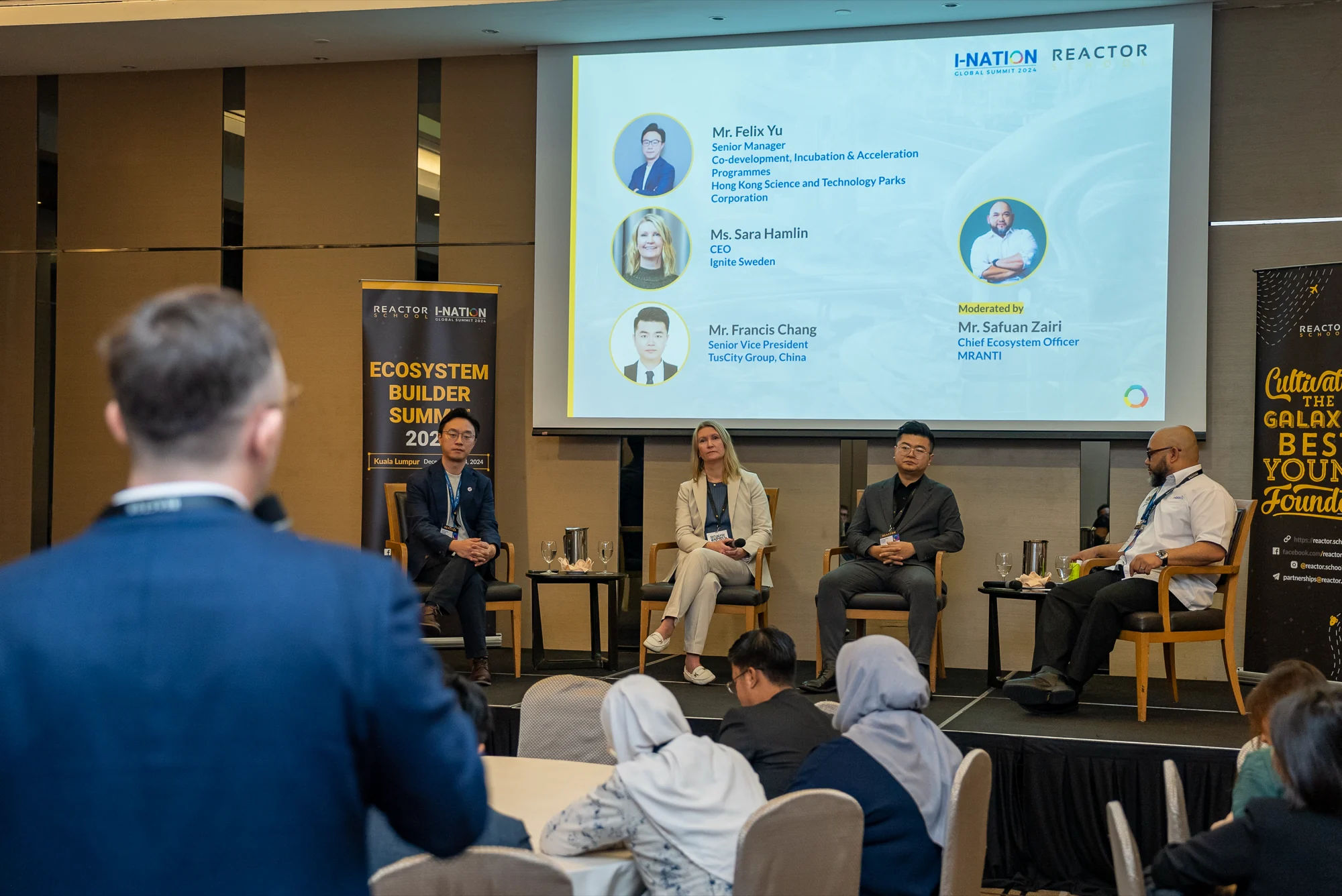
The firm is Reactor’s associate for the European Union. The mandate: localise a programme proven in Asia for European institutions, and build the alliances with schools and universities that carry it. The method Reactor teaches is effectual, reasoning from what is actually at hand, and it travels well because it is not tied to one market’s playbook.
I contribute to cultivating the next generation of global founders across Europe.
Pierre Blanquett
Market development
Schools, universities, youth organisations
Where Reactor’s programmes and methods fit: high schools, universities and youth organisations across the EU.
Partnerships
Alliances that carry the programme
The partnerships through which the school co-creates, designs and runs programmes and curricula, built and kept.
Localisation
Proven in Asia, made for Europe
The programme localised for European institutions.
Representation
The school in Europe
Reactor at its European events, and its wider network, Reactor Pathways and Reactor Ventures, open to European founders.
03The method.
Effectual reasoning
Start from what is at hand, not from a forecast.
Reactor’s programmes rest on one shift, from causal to effectual reasoning. A causal plan starts from a goal and looks for the means to reach it. An effectual founder starts from the means at hand (who they are, what they know, whom they know) and lets the goal take shape as partners commit. The school calls entrepreneurship education a critical enabler for young minds for that reason.
Exhibit 3Two ways to reason
The school’s values say the same in its own words: move fast, be bold, people first. Students make firm decisions and own their successes and their failures; they practise design thinking, validate ideas and pitch, and leave with work for a portfolio.
Exhibit 4Three steps of one school
Entrepreneurship education in high schools and universities: design thinking, validated ideas, a pitch
After-school programmes for young entrepreneurs
Strategic support and investment for student startups under thirty
04Into Europe.
The European Union
A programme proven in Asia, carried to European institutions.
The work in Europe has three parts: the programme localised for European institutions, the alliances with schools and universities that carry it, and the school represented at its European events. The modular build is what makes it portable: an institution can take a single workshop or a sprint of several weeks and run it itself.
Exhibit 5From Singapore to the European Union
- 2012 ~ todayProven in AsiaMore than 195 programmes in the past three years, more than 70 universities.
- Step oneLocalisedThe programme adapted to European institutions and their school systems.
- Step twoAlliedSchools and universities across the EU that carry it.
- Step threeRepresentedThe school at its European events, its Pathways and Ventures open to European founders.


The aim: European students and educators with the same resilient entrepreneurial mindset the school built in Singapore. The engagement is ongoing.
05What the company gets.
Venture & Market
If your programme, school or company is proven in Asia and has to be carried into Europe.
The firm takes the associate role through its Venture & Market door, Intention → Attention → Retention, with the two other doors on call.
Intention
Where it fits
The institutions, countries and partners to start with, and what the first year has to prove.
Attention
Localised and allied
The offer adapted to European institutions, and the alliances that carry it.
Retention
Represented
Present at the events and in the networks where the next partner is met.
On call
Sourcing & Supply ~ Design & Development
Factories, packaging and product, when the venture makes things.
24 h
A person answers the brief
48 h
Feasibility check: go, no-go, or what is missing
7 days
A formal RFQ from two to three vetted factories, as one landed-cost matrix
1,000+
Units per production run, to 10,000 and more
How it starts: the brief through the intake. A person answers inside 24 hours; the feasibility check follows inside 48.
06Sources.
Read on 6 October 2026
- Reactor School
- Reactor School: about us
- Pierre Blanquett: the Associate, EU role at Reactor School2026